
This month, Brian McAvera explores the work of artist Tom Bevan. ‘Artists from the Archive’ articles are drawn from NIVARLA, our Northern Ireland Visual Art Research Library & Archive.
Why do some indifferent artists become well-known while other substantial artists languish by the wayside? Art criticism and art history are uncertain bedfellows, and the history aspect depends as much on luck as on talent. Artist Tom Bevan is one of those who came to prominence in the eighties, along with Gerry Gleason, Victor Sloan, Marie Barrett, Una Walker, Maurice Hobson and many more.
Although born in Belfast in 1946, and although he studied History and Psychology at university (he left without taking a degree), his formative years were spent in Guernsey, working in commercial potteries. The skills acquired there were burnished when he returned to Northern Ireland in the eighties, though this time to a barn in deepest countryside outside Crossgar.
Work of that period crossed his pottery skills with those required to make sculpture, in his case assemblages, often on a large scale. He was an inveterate bin-hoker (the word is his), acquiring material from roadside, skips, and the countryside. He was adept at taking living wood in the shape of branches, stripping off the bark and bending/manipulating the wood into any shape he wished. He was low-tech, often casting in his fireplace, even using cement as a binding material.
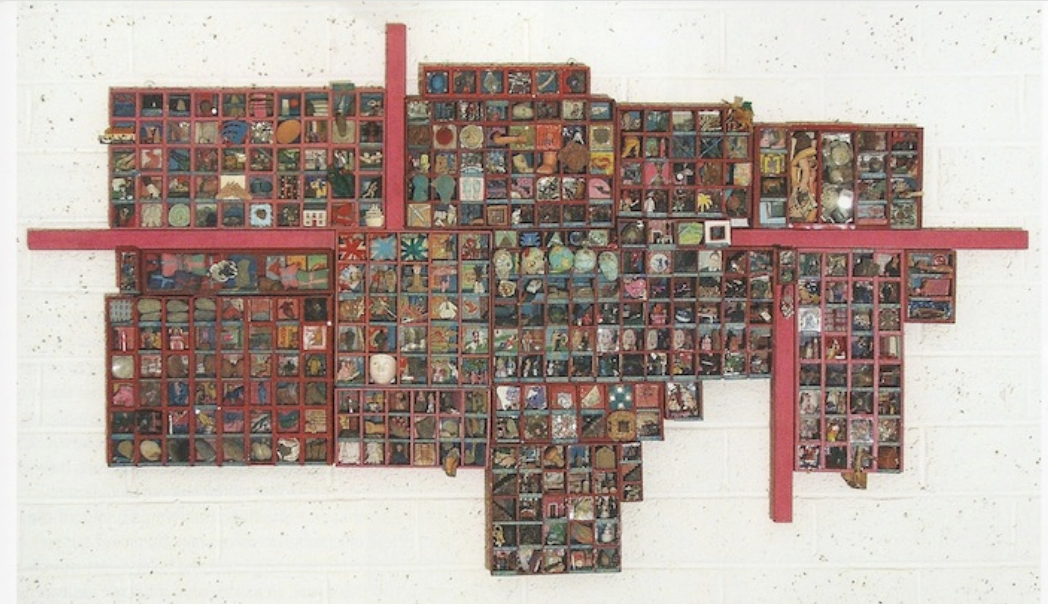
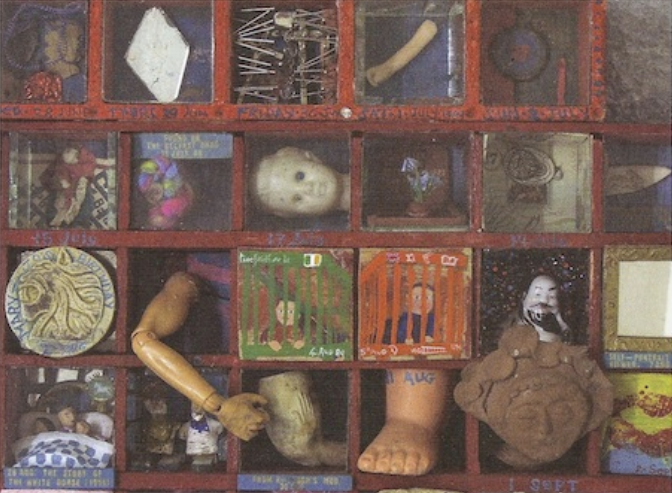
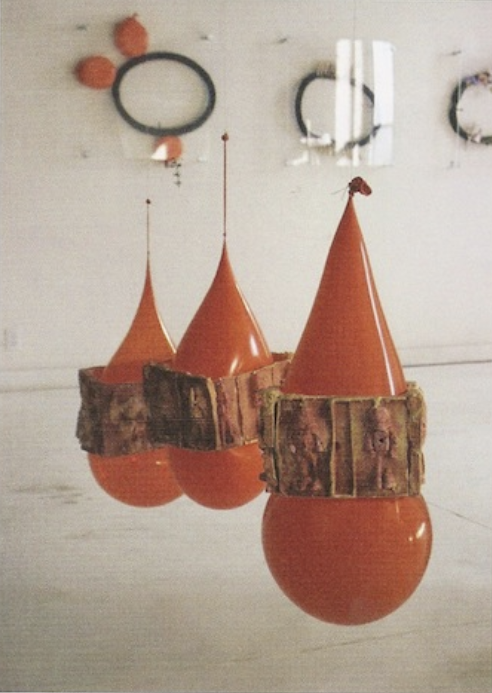
Nothing is Lost, 1989, Tom Bevan; detail from Nothing is Lost; Fragile Game, 1998-99, Tom Bevan. Photos courtesy of the artist.
Early work was primarily hand-built in clay. Often roundels would be attached to a strip of wood. Soon however, he began to expand, and a strong socio-political aspect began to insinuate itself into the work. He kept detailed diaries (some of them now lost) of the day’s events, including the making of his sculptures or other artworks such as collages and drawings. Like several Irish artists I know, he was a voracious reader, especially of novels and non-fiction, and his range of reference in matters artistic was unusually wide, with a particular interest in Tribal art.
The wide range of reference and his socio-political interests came together in his masterpiece, a large assemblage called Nothing is Lost which contained 365 wooden boxes, one for each day of the year. They were rooms into which you could peer, scenarios based on what had happened to him during a given day: what he had seen, heard, read about, picked up on the street: a veritable sociology of the North; 365 probes into the Northern psyche.
Made in 1989, I exhibited this work in Parable Island, the show I curated for the Bluecoat in 1991, and then again in the Collective Histories exhibition Icons of the North at the Golden Thread Gallery in 2006.
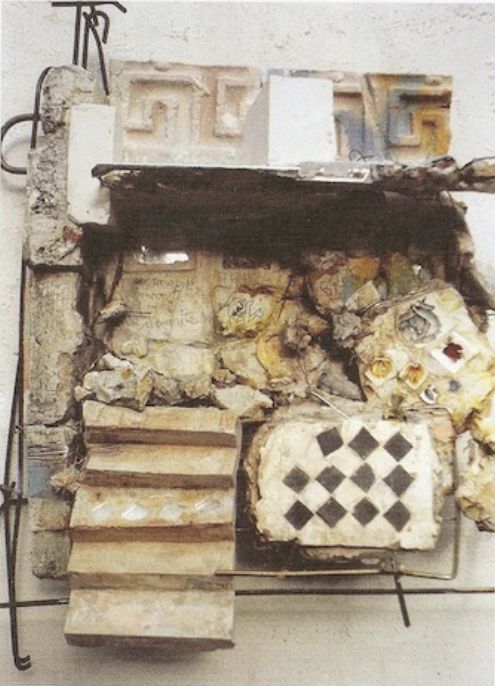
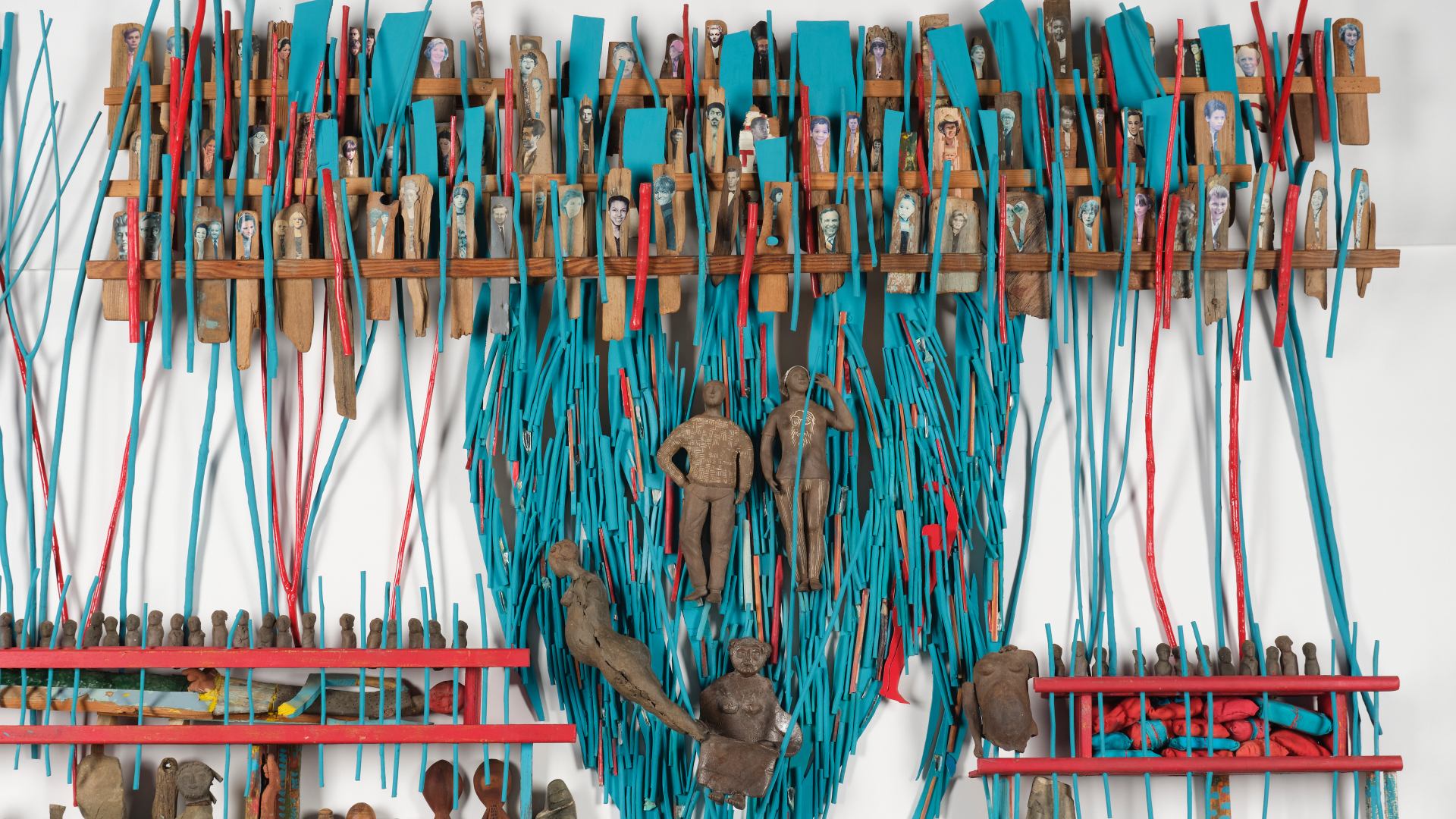
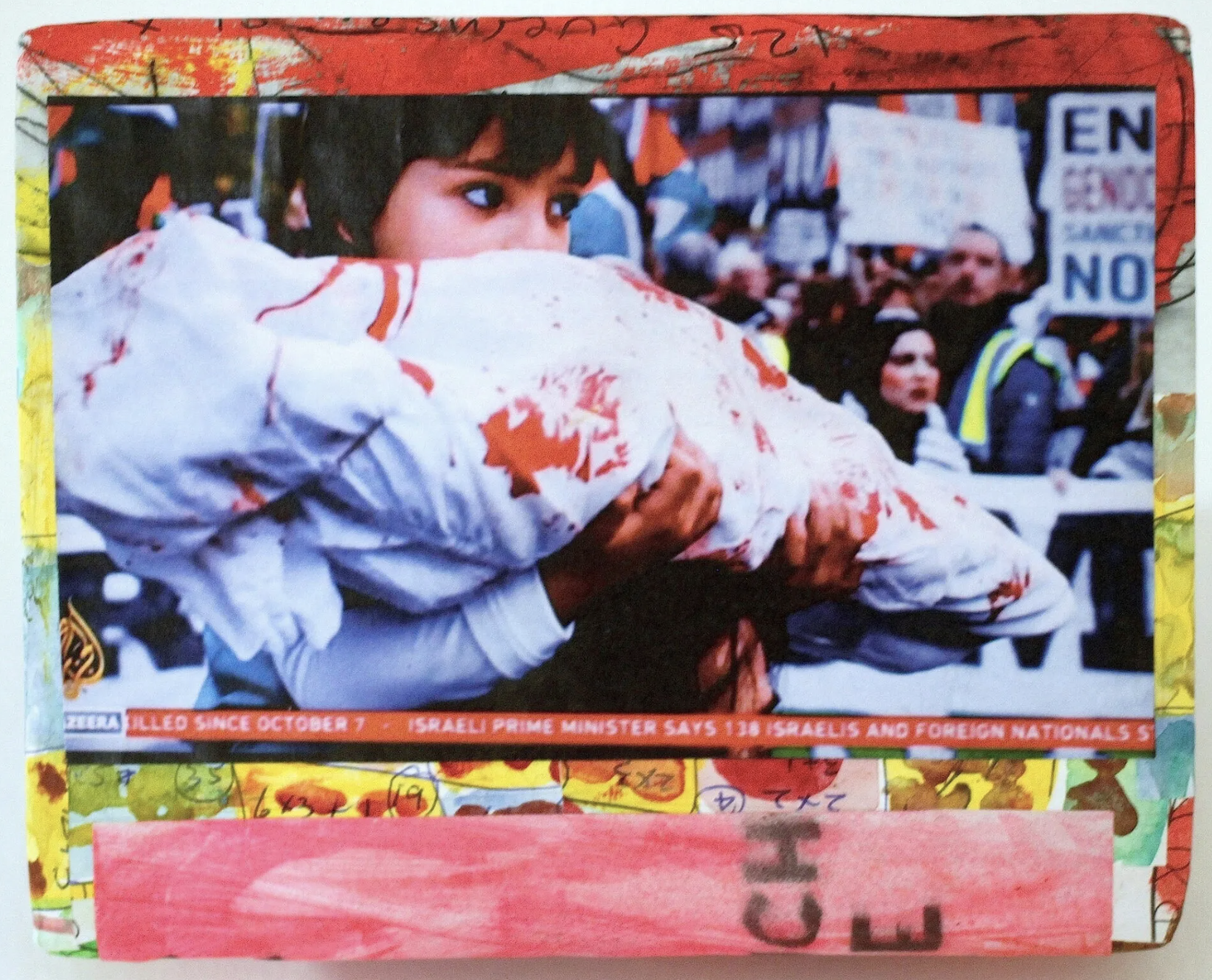
Loading Bay, 1994; The McAvera Altar Piece, date unknown; Gaza Protest, 2004; all works by Tom Bevan, photos courtesy of the artist
After a one-person exhibition at the then Arts Council Gallery in Belfast in the early nineties, he won the MOMA P.S.1. Scholarship to New York, which lasted a year. He met a Japanese artist who became his partner, and so he decided to stay in New York and spent almost a quarter of a century there before returning to the North of Ireland. In New York. Not surprisingly, his work mutated. Collage became much more prominent, often with a political edge. Sculptures often became more abstract. (You can read about them and see many of them in an interview that I did with him for the American magazine Sculpture (January 1998) which is in the NIVARLA archive.)
More recently he collaborated with artist Leontia Haldenby on Serious Play, a marvellous exhibition for Down County Museum. Bevan’s work for the exhibition recalled Nothing Is Lost, only in a different key. Out of 300 cubes, roundels, and pyramid shapes, of which 200 were in the exhibition, Bevan’s work produced what was in effect a series of (seemingly) children’s building blocks, each one covered on all sides with imagery, much of it sourced from the internet and then printed out in colour. Threaded through the imagery – which on initial inspection seemed to be standard children’s imagery sourced from comics and books – one realized as one turned over the cubes or roundels that much of the imagery was socio-political and that words and phrases had been added, pointing up everything from Global Warming to the plight of women in Afghanistan. A double focus: a children’s world with intimations of the real world outside the safety of the home.
Always inventive, always intelligent, always visually interesting Tom Bevan is, like Gerry Gleason, one of the unsung troubadours of the North.
Brian McAvera, July 2025
We’ll share new articles inspired by NIVARLA by Brian every week. And you can enjoy more of his writing on his own site here.
NIVARLA will be open to the public later this summer, and items in the rare and special collection will be available to view by appointment. We will share more information on how to access and use NIVARLA soon!
The Northern Ireland Visual Art Research Library & Archive is supported by the Ampersand Foundation, with many books and archive items donated and on loan from the McAvera & Walker Library.
Help fund our work
Through a one-off or repeat donation, you’ll enable us to continue showcasing art and culture with our community.
Supported by