A tribute to David Crone 1937-2026
All of us here at the GTG were saddened to hear of the passing of renowned artist David Crone in July of this year. Brian McAvera has written this tribute to David, his friend for many years.
~~~~~~~~~~~~~~~~~~~~~~~~~~~~~~~~~~~~~~~~~~~~~~~~~~~~~~~~~~~~~~~~
When myself and S.B. Kennedy did the first of the GT Collective Histories, entitled Post-War Pre-Troubles in 2005, the first part of the catalogue consisted of an interview between myself and S.B. on post-war Northern Irish art, in the course of which, when discussing those artists who came to prominence in the 1960’s, S.B. remarked that ‘Crone, I am sure, is the major painter of his generation: he’s a man who, for me, echoes and conveys in his work the same relevance, pulse and vitality for life as does Jack B. Yeats’. In the final section of the catalogue, I added that the painter would ‘rapidly develop into one of the key figures in Northern Irish painting’.
Davy Crone attended Annadale Grammar School from 1950-56, then the Belfast College of Art, following this by teaching at Larkfield Secondary School in Belfast from 1961-63 and he then taught at Annadale Grammar from 1963-75. In that year he became a lecturer in what was then the Northern Ireland Polytechnic (it became the University of Ulster) where he lectured up until retirement. As an artist he was represented in the North by the Fenderesky Gallery, in the South by The Hillsboro, and in London by the John Martin Gallery.
Davy was a quiet man, slow of speech, ruminative, and an excellent teacher who taught by example. I remember, in the nineties, doing several sessions for him when he was running the M.A. course at the art college. Always, there he would be, at his large easel, working away, doggedly. Often, he would pause, take a few steps back, then walk the length of the painting, back and forth, before, having ruminated, he would slowly move forward to apply a brushstroke.
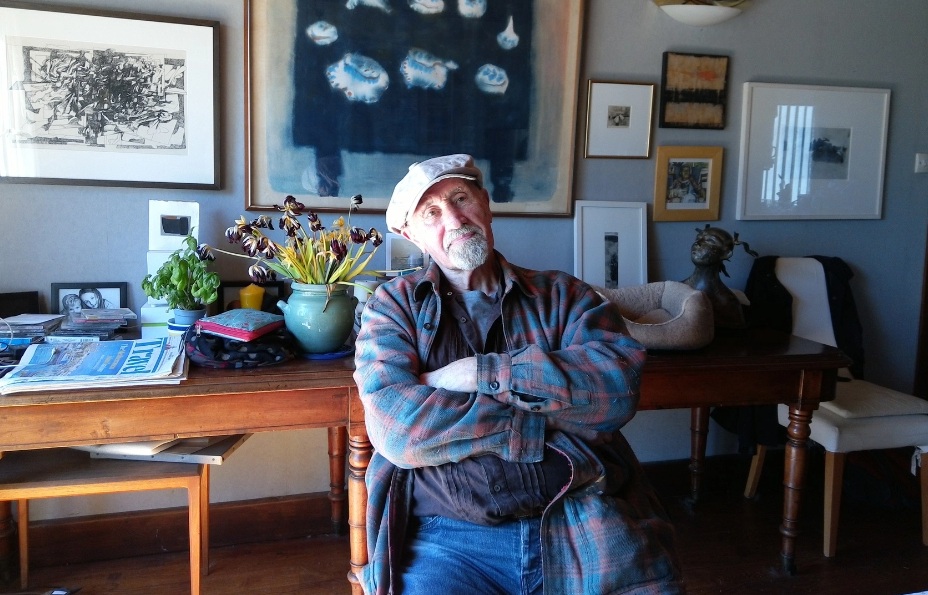
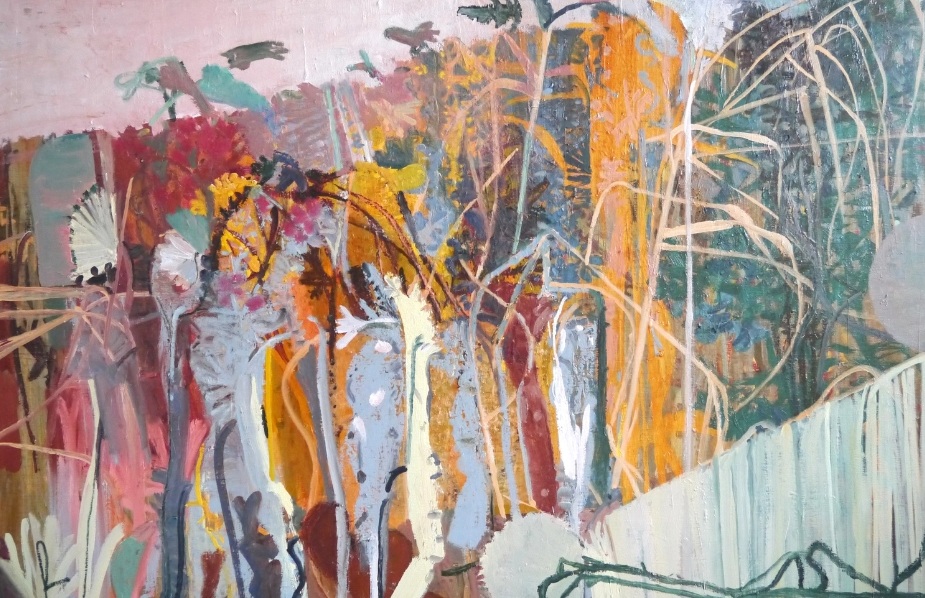
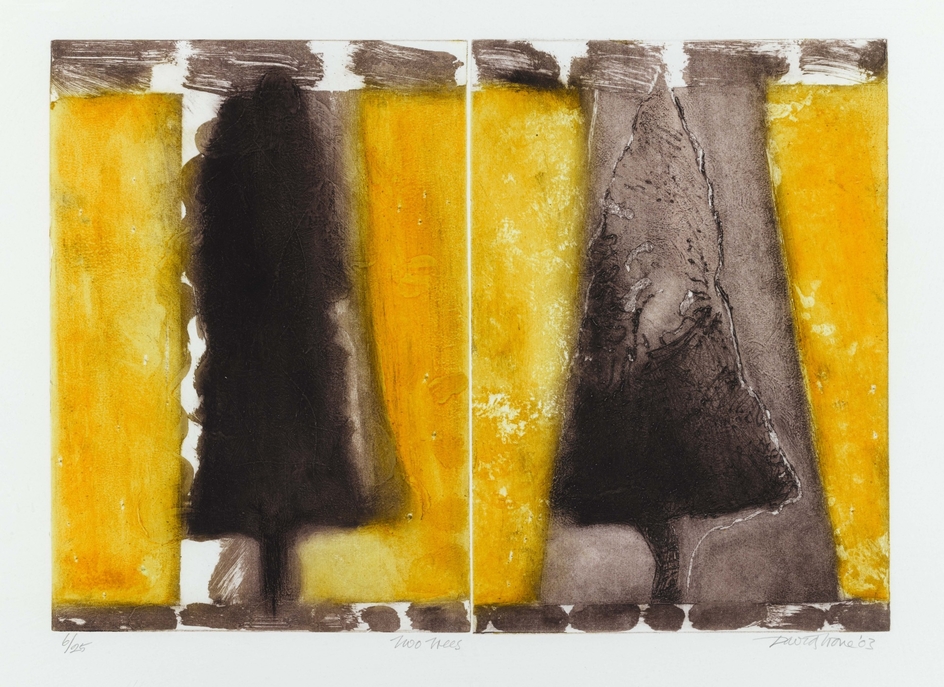
(l-r) David Crone; Meadow by David Crone (2006), ACNI Collection; Two Trees by David Crone (2003), Art UK
When I put him in an exhibition I had curated for the Bluecoat in Liverpool in 1991, I wrote that ‘David Crone, trying to reconcile the romantic and the rational, the figurative and the abstract, searches for an edge and finds an anxiety. His Euston Road tradition subverted by an abstracting perceptual uncertainty, is really the work of a formalist who has found that the unconscious currents of memory, of the dark side of the psyche, are continually being dredged up. Nothing is certain in his world: autobiography (the ghostly scenarios of figuration) is a metaphor for lack of trust in the facility of painting.’
This ‘perceptual uncertainty’ came to the fore in his ‘window’ paintings. The French photographer Atget did a famous series of Windows in which the reflections of passers-by mingled with the contents of the interiors of the windows. The effect was often surreal. With Davy, the windows being in Belfast, the period being The Troubles, what we had reflected and refracted in the work was the uneasiness, the anxiety and the odd surreal moment that were the norm for us at the time. S.B. and myself at one point wanted to do an exhibition contrasting Basil Blackshaw’s Window series with that of Davy Crone’s, but it never materialised.
In the mid nineties the town man moved to the outskirts of Ballynahinch and became a countryman. His studio was a very large portacabin in a field behind his house which had a fine view over the surrounding countryside. Any time I visited, he was usually working an a very large canvas, with jazz music playing very quietly in the background. Ironically (there being no students around) he seemed to have much more room to move around in the portacabin that he ever did in the big teaching spaces of the college. Up and down, he would dander, every now and then leaning in to apply a little dash of colour: balance was everything. As he tended to paint what was around him, cityscapes became countryscapes.
He was an intriguing colourist. If you flick through a range of his catalogues, what surprises is the colour variation. He could at times be distinctly ‘sour’. He could also make dark colours blaze. And he was working right through to the end. On the current Fenderesky Gallery walls are a selection of his latest work.
Let’s hope some enterprising museum does a serious retrospective of his work – and soon.
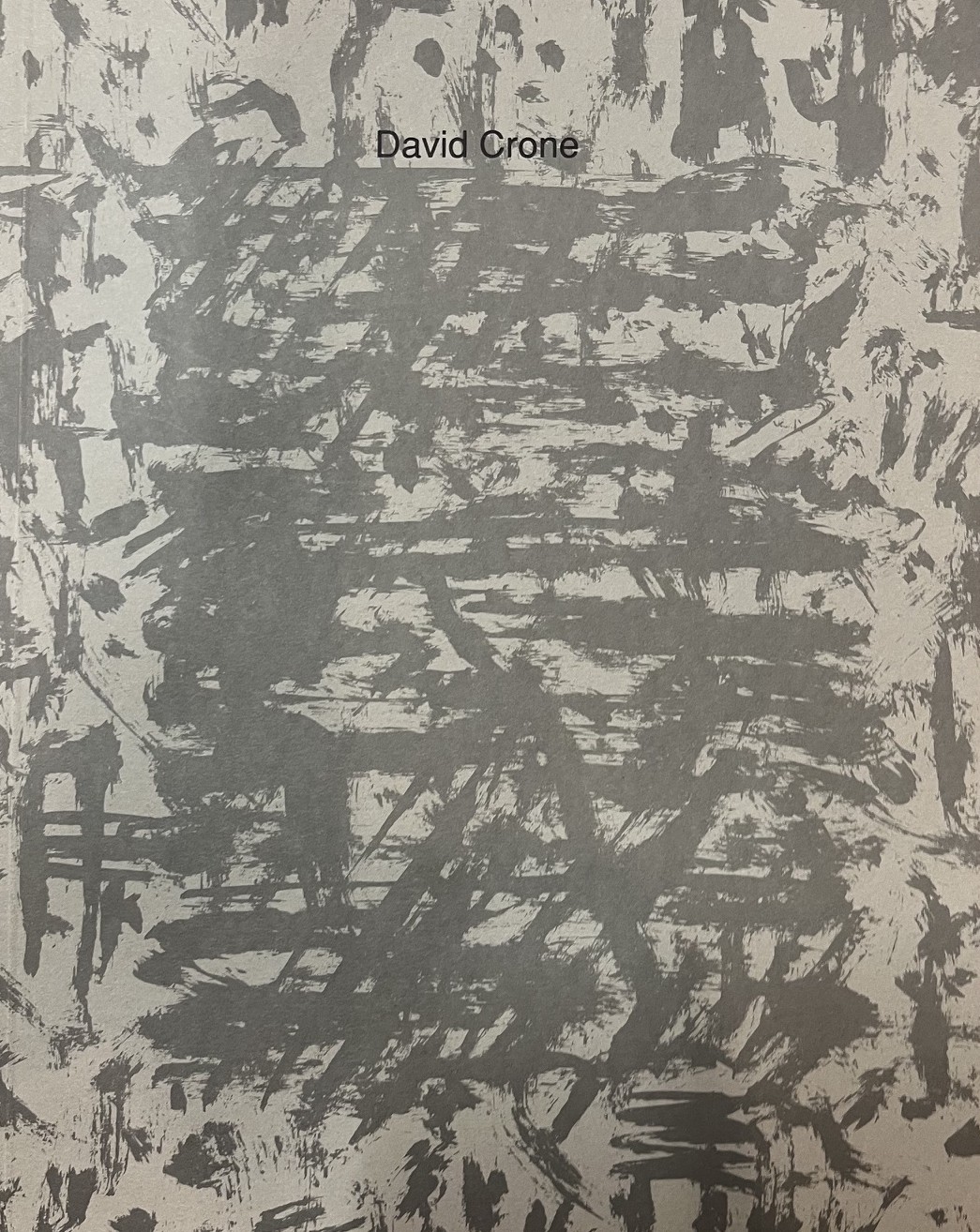
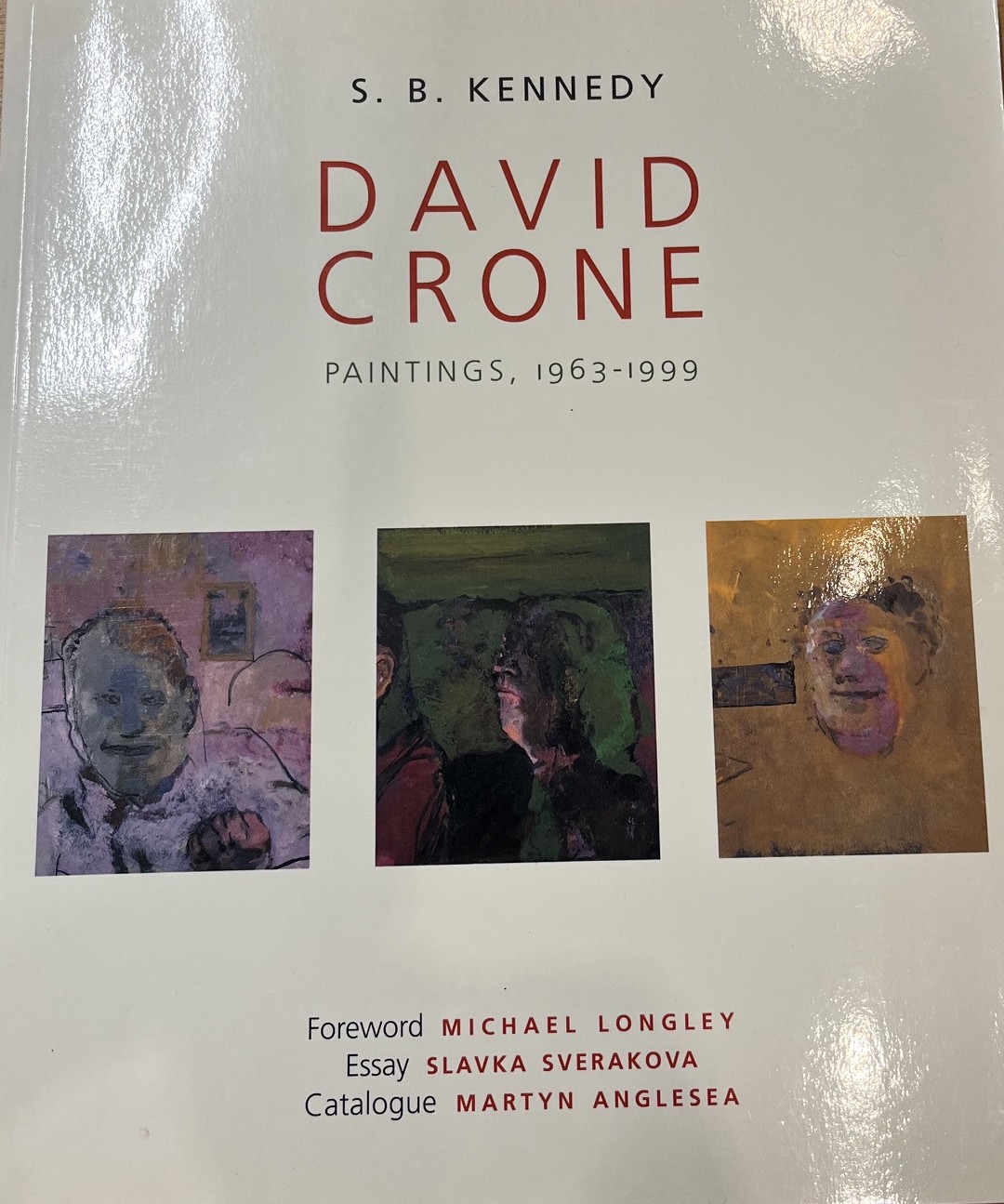
(l-r) catalogues of David Crone's work available in NIVARLA
Brian McAvera, August 2026
Golden Thread Gallery is supported by:

Help fund our work
Through a one-off or repeat donation, you’ll enable us to continue showcasing art and culture with our community.
Supported by