
Jacques Joseph Tissot (1836 – 1902), better known as James Tissot, was a French painter, illustrator, and caricaturist. Malcolm John Warner (born 1953) is an English art historian and curator who lives in the United States. Dr. Warner has served as the director of the Laguna Art Museum since January 2012.
Although described as a book by its publisher, The Medici Society, this 1982 publication is actually more of a pamphlet, being a mere twenty-four pages, pages which include thirteen black-and-white and twenty colour illustrations. Described thus, you might think it was of slight consequence. But in fact, it is an ideal introduction to the world of the French painter and printmaker James Tissot.
Born in Nantes, Tissot moved to Paris around 1856 to study art, enrolling at the at the Ecole des Beaux-Arts. His friends and peers included the American painter James McNeill Whistler, and French painters Edgar Degas and Édouard Manet. Then in 1871, in the wake of the Prussian invasion of Paris in 1870 (Tissot joined the National Guard as a sniper) and then of the extirpation of The Commune in Paris, which Tissot seems to have supported, he relocated to London, anglicizing his first name in the process, perhaps at the instigation of his friend Whistler.
Tissot was not a modernist, but he was a painter of the modern world, in particular the world of the leisured middle classes. By the time he was thirty he was able to buy himself a mansion in the Bois de Boulogne. As well as Degas, Manet and the aforementioned Whistler, he counted the novelist Daudet as one of his circle. He was also a superlative craftsman. Admired in his day, and critically acclaimed, after his death, the reputation slowly vanished and people saw only the elegant subject matter, relegating him to the equivalent of the society portraitist.
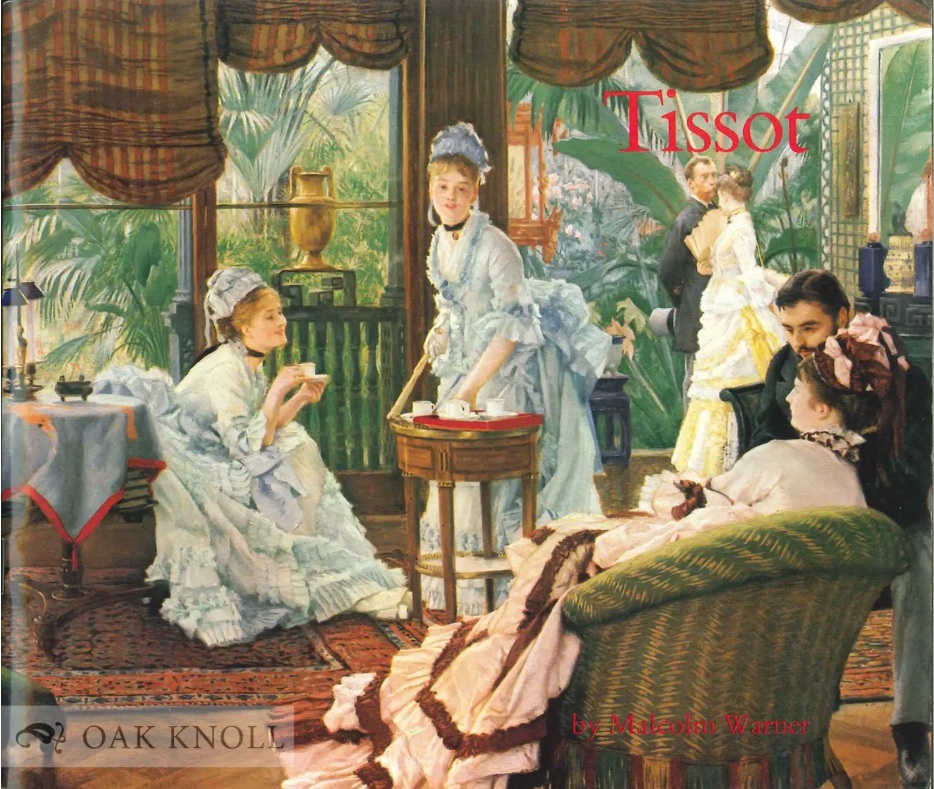
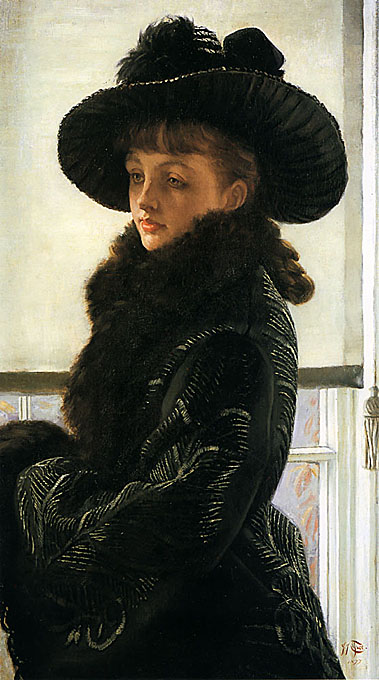
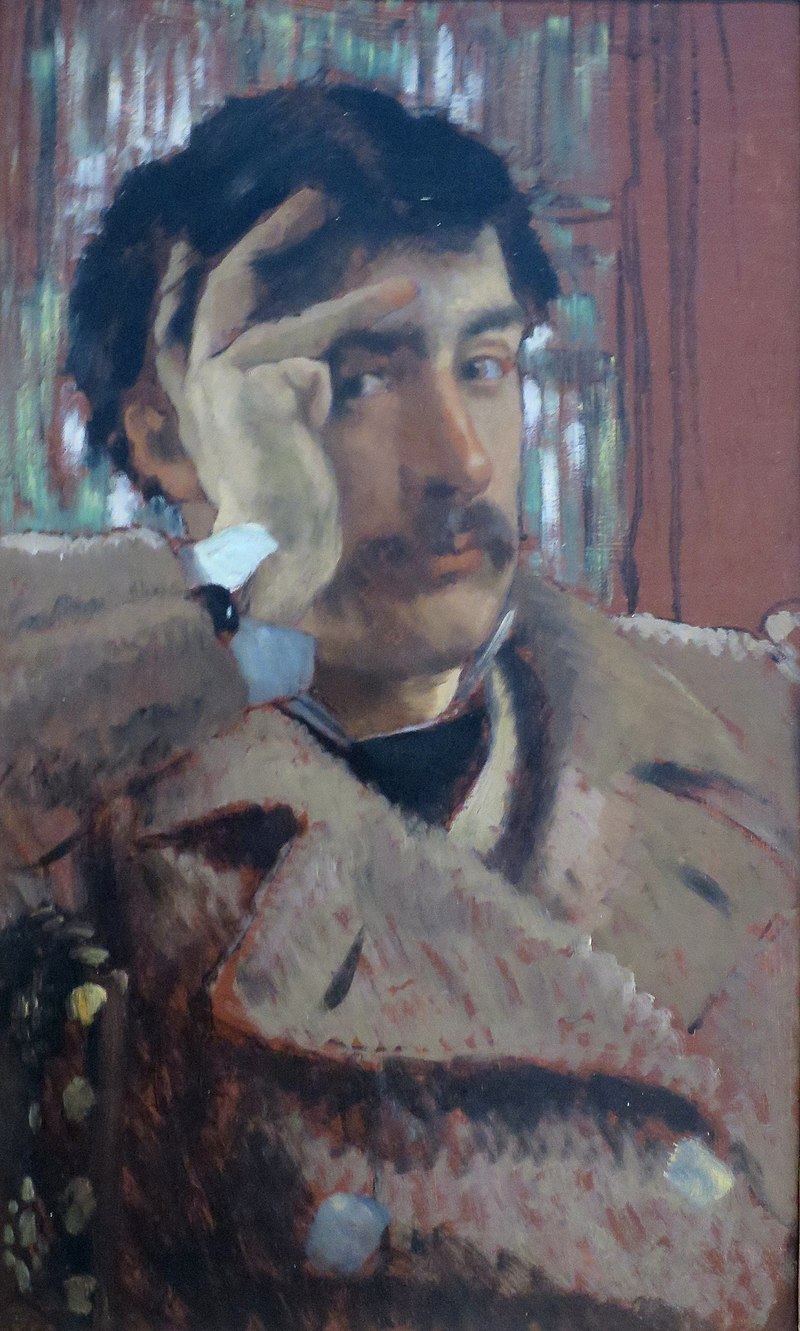
(l-r) front cover of 'Tissot' by Malcolm Warner; Self-portrait by Tissot, 1865; 'Mavourneen' by Tissot, 1877 with Kathleen Newton as model.
How do you reduce a long and complex life to a few dozen images and a few thousand words? Most critics and biographers cannot. There is a real art to the selection of significant detail, to the proportioning of words in relation to a life’s journey; to the selection of significant images so that an artistic journey is sketched in, lightly but pertinently. And of course, one wants insights into both life and art, but without the oppressive weight of a biographical or critical tome. Malcolm Warner can do all of these things.
We learn that in London Tissot fell in love with Irish-British model Kathleen Newton. A divorcee with children, she was first his model and then his lover. In 1887, she moved in with him. Not the done thing then, in Victorian London. Six years later she died of consumption. He was forty-six. She was twenty-eight. A month later he moved back to Paris.
Her death seems to have affected him profoundly. Although born a Catholic, he had never been religious. Now he was a convert. The paintings changed. Instead of fashionable scenarios, he travelled and did detailed research in the Holy Land, eventually producing large, illustrated tomes on the Life of Jesus, and on the Old Testament. They were hugely popular in their day. Now, they are forgotten, though no doubt some young historian will rectify that.
What is not forgotten however, and is attracting increasing attention from scholars, is his earlier work. Like Degas, and like Caillebotte, he was structurally superb. Artfully, as in a photograph, people or objects might be cut off at the edges, thus giving the impression of spontaneity, but if you analyze any given painting, you will soon observe how deftly he compresses space, manipulates it, and how he provides one with the elements of a narrative but, unlike so many Victorians, refuses to be heavy-handed about it, leaving the viewer to work out the possible implications.
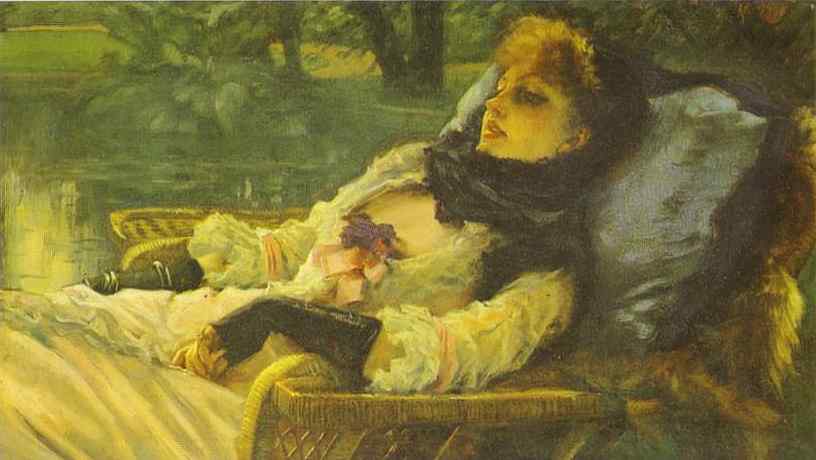
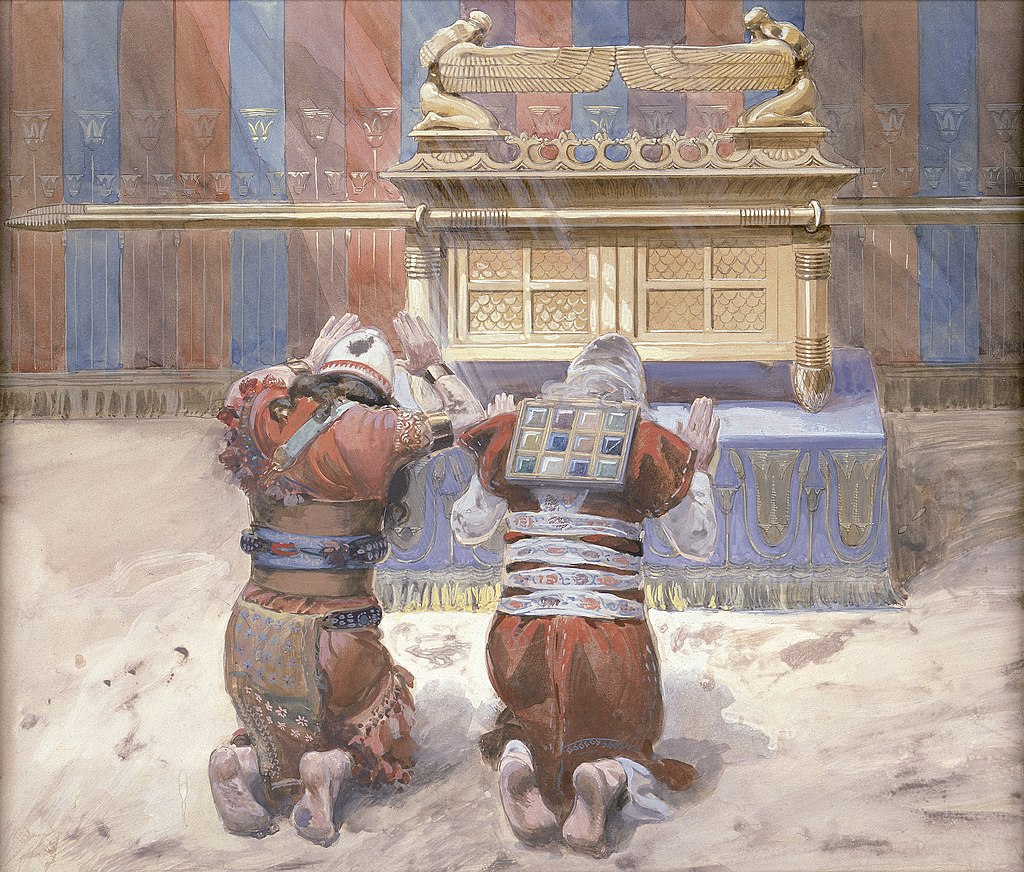
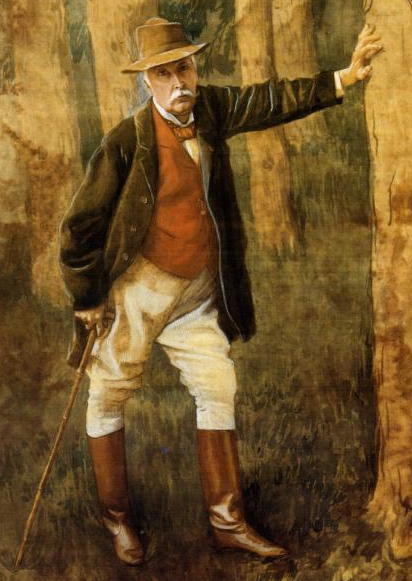
(l-r) Paintings by Tissot: 'The Dreamer', 1881; 'Moses and Joshua in the Tabernacle', c.1896; self-portrait on silk, 1898
Brian McAvera, August 2025
We have a copy of Tissot by Malcolm Warner in the NI Visual Art Research Library & Archive at the Golden Thread Gallery. NIVARLA items in the rare and special collection will be available to view by appointment. We will share more information on how to access and use NIVARLA soon!
The Northern Ireland Visual Art Research Library & Archive is supported by the Ampersand Foundation, with many books and archive items donated and on loan from the McAvera & Walker Library.
Golden Thread Gallery is supported by: 

Help fund our work
Through a one-off or repeat donation, you’ll enable us to continue showcasing art and culture with our community.
Supported by