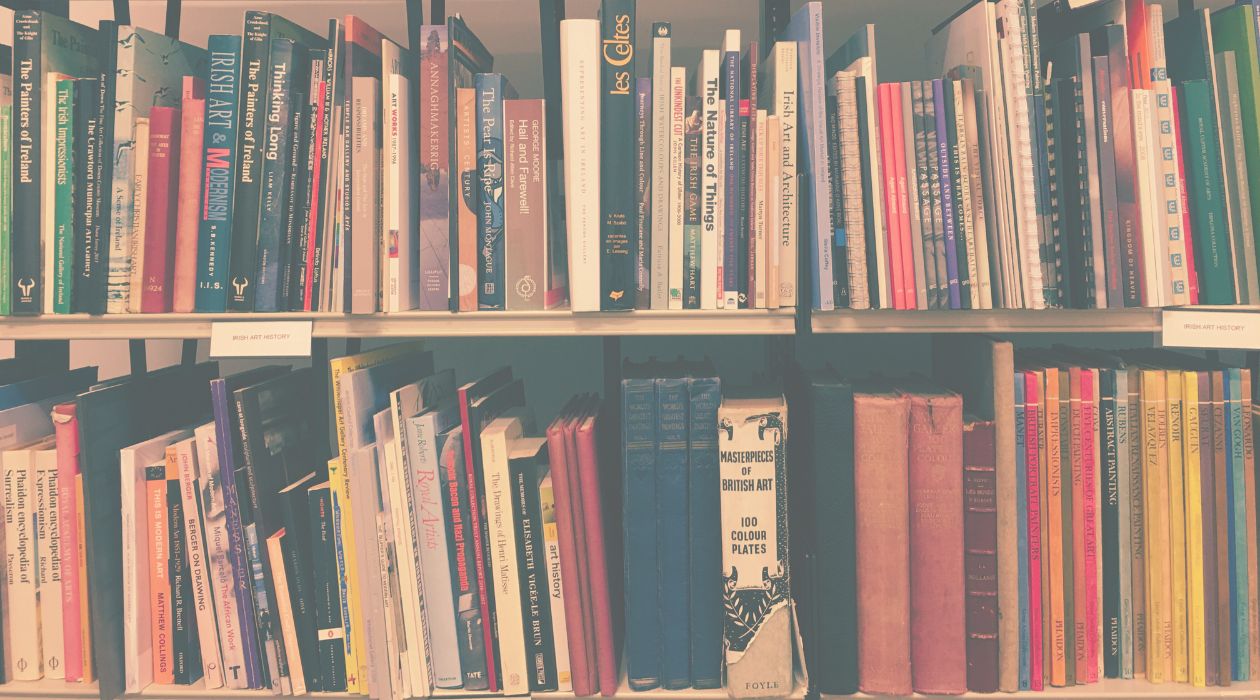
Brian McAvera’s new ‘Artists from the Archive’ articles are drawn from NIVARLA, our Northern Ireland Visual Art Research Library & Archive.
One of the great unsung artists of The Troubles was a young man called Maurice Hobson . To understand his achievement you need to remember what photography was like in Ireland in the mid-eighties. At that time the photographic tradition had been primarily documentary. Many books were produced on earlier practitioners such as Alex Hogg, Robert French or Robert Welsh. Publishers such as Friar’s Bush Press specialized in bringing out photographic albums that were primarily topographic or local-historical, while contemporary photographers tended to produce documentary style work on themes such as Ulster architecture, Travellers, or Disability issues. And of course, there was no shortage of photo-journalism.
In my first published book, Art, Politics and Ireland (Open Air, Dublin, 1989) I argued that ‘Photography lies. The single pristine image can be converted to propaganda with the utmost of ease…Seeing is believing only to the innocent eye. The single image simplifies substance into ideology. The soldier with his looming weapon dominating a small child, to take only a recognized cliché, is a propaganda statement, not an exploration, Such images are incapable of breathing the oxygen of context; they deracinate the complexities of history and politics and social articulation; they fasten onto myth, propaganda and state control with the ease of a practiced liar’ (p. 97).
Into this world came Maurice Hobson. He was a quiet man who had a flat in the university area which was where I interviewed him on a number of occasions. His face bore the scars and deformations of much surgery because he had, like so many others, been caught up in a bomb blast. But he had survived, although the bombing left him, in addition to the mutilations, with epilepsy.
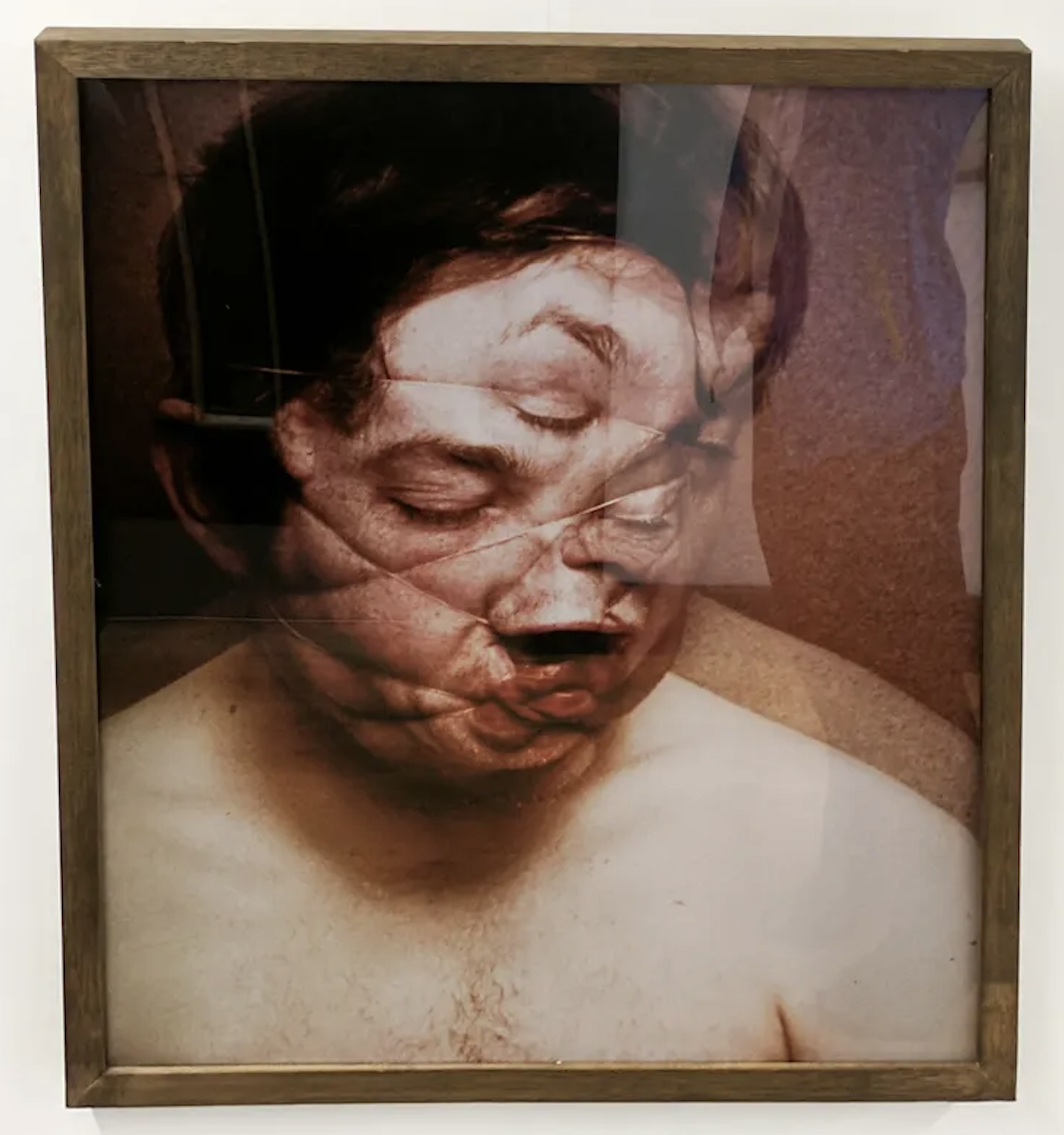


Photographs by Maurice Hobson
Maurice produced self-portraits, but they were like no self-portraits that I had ever seen before. He wanted to recreate the experience of being a bomb victim, and he did so in a highly imaginative way, and with the simplest of means. He took elastic bands of varying sizes and thicknesses, stretched them and pulled them tightly over the folds of his face, thus providing an elaborate externalisation of sutures and stitching. It sounds simple, doesn’t it, yet the results were complex and arresting: the human body seen as a site for spare parts; hideous deformities awaiting the surgeon’s skill; the forcible reconstruction of the living tissues of a bomb victim.
He would overlap or cut together such images in a way which was deeply disturbing. You could read the images in various ways. Was this the atrocity image: the image in the wake of the explosion; or was this what the victim would have to live with for the rest of his life?
Instead of the numbing effect of photo-journalism, Hobson displaced and replaced it with a cool, compassionate lucidity. He redefined the atrocity image. What he pinned down with an almost entomological precision was the state of looking sub-human while at the same time being only too human. These are not deracinated images, emptied of content. These are not propaganda images, promoting an ideological line. Rather they are images which, although difficult to look at, remind us simultaneously, not only of man’s inhumanity to man, but also of man’s essential humanity. They say, clearly and compassionately, that, even if the human body is subjected to appalling injuries, man’s essential humanity will still remain.
Tragically, just a few days after I last interviewed him, Maurice Hobson had an epileptic attack and died. He was just 29 years old.
Brian McAvera, March 2025
We’ll share new articles inspired by NIVARLA by Brian every week. And you can enjoy more of his writing on his own site here.
NIVARLA will launch formally this Spring, and items in the rare and special collection will be available to view by appointment. We will share more information on how to access and use NIVARLA soon!
The Northern Ireland Visual Art Research Library & Archive is supported by the Ampersand Foundation, with many books and archive items donated and on loan from the McAvera & Walker Library.
Help fund our work
Through a one-off or repeat donation, you’ll enable us to continue showcasing art and culture with our community.
Supported by