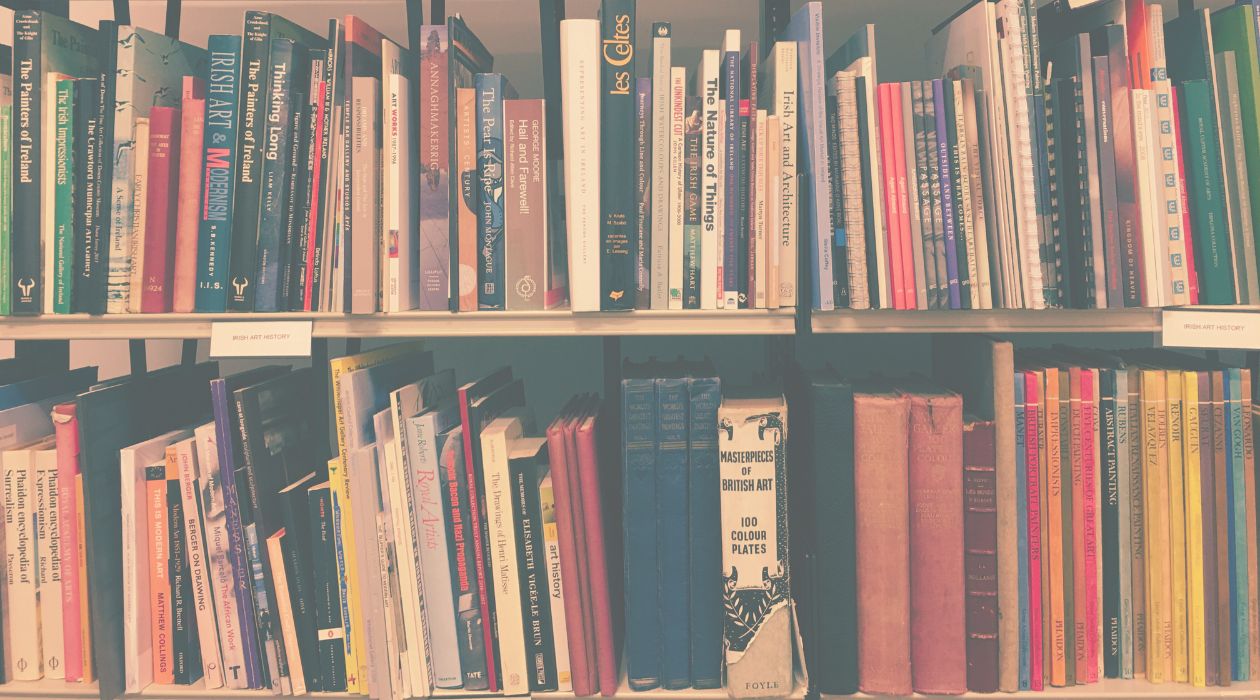
Brian McAvera’s new ‘Artists from the Archive’ articles are drawn from NIVARLA, our Northern Ireland Visual Art Research Library & Archive.
Let us be blunt.
If you read a history of, say, the Spanish Civil War, the Mexican Civil War, or of Germany in the first half of the twentieth century, you will find it illustrated by the artists who responded to their Troubles. Not so the Northern Irish Troubles. Right from the start, the art world and the academic world did not want to know. The Ulster Museum did not collect these artists: they preferred to collect British or foreign artists who came for the quick incursion. The Arts Council of Northern Ireland did not collect them. And most certainly English museums and galleries, with the notable exception of Wolverhampton, did not collect them nor did collecting agencies such as The Contemporary Art Society. Needless to say, the Republic of Ireland, happy to eulogize the Men of 1916, was not interested either. And as for the universities, well, they were quite happy to deal with poets who supposedly dealt with The Troubles, but artists? Hell no…. Brendan Ellis, Maurice Hobson, Jack Pakenham, Graham Gingles, Gerry Gleason, Una Walker, Marie Barrett, and Tom Bevan were committing career suicide by bearing witness to The Troubles. Those who persevered, still are…
Of course we now live in a world where revisionism rules. One collector even said to me: ‘Artists of The Troubles. Don’t they paint guns and bombs and things?’ Was he imagining that the world of The Troubles was one in which you painted nice little landscapes whilst supping tea in the Europa Hotel?
As I said: let us be blunt. The majority of Northern Irish artists ignored The Troubles. And that was their right. Many of them were too old, too set in their ways, or lived well away from the urban violence. But those who responded, those who bore witness, should never have had to endure the obloquy, or the oblivion that was so often their fate. I will deal with many of the others in future articles, but let us start with Jack Pakenham, who can claim to be the greatest of them all.
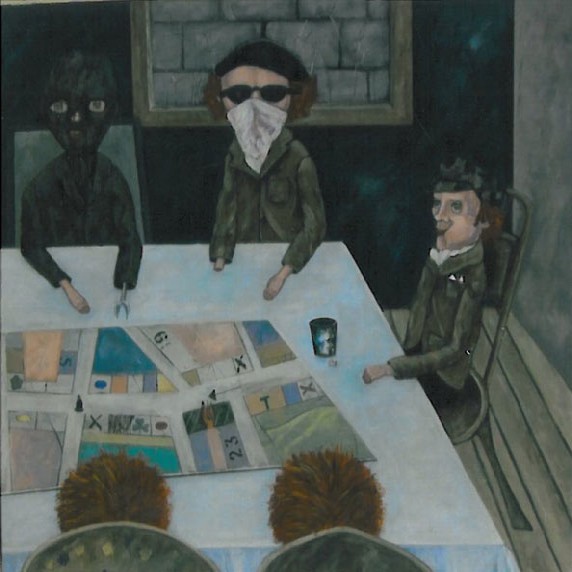
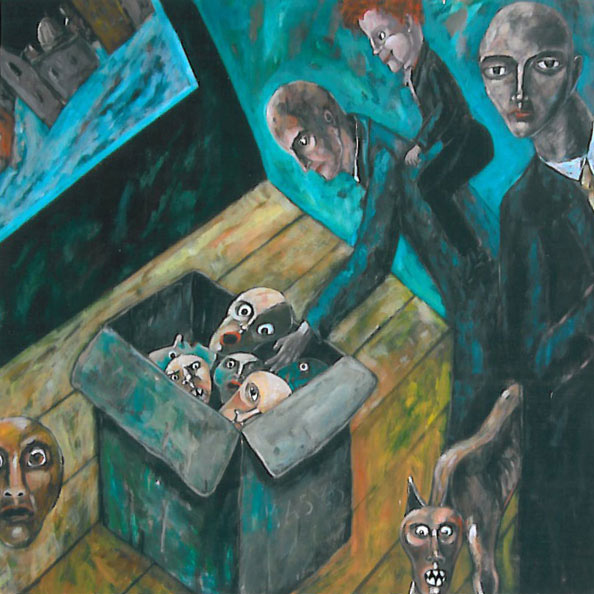
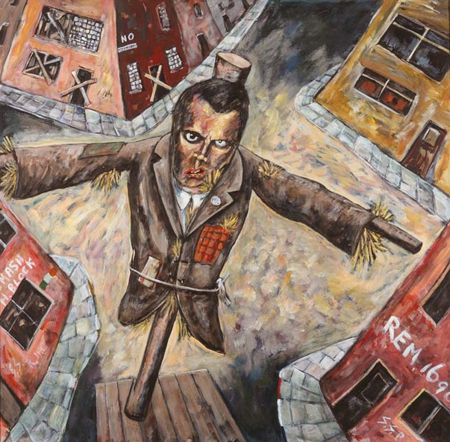
Paintings by Jack Pakenham (l-r) 'Your Move' 1976; 'Picking the Masks' 1986 ; 'Ulster at the Crossroads' 1986
One of the first artists to respond in any substantial way, he was perhaps an unlikely figure. Born in the Republic of Ireland (1938), although brought up in Belfast, he studied French, Spanish and Philosophy at Queens University, spent longish periods in Ibiza, and then in Dorset in England, before becoming Head of English in a secondary school in Belfast. He was also a published poet. His early Pre Troubles work has much in common with post-war art and literature, from Francis Bacon to the Theatre of the Absurd, dealing as it did with tragedy, alienation, and the world of suffering.
As he has often remarked, the major problem was that, being forty-one when The Troubles started, and thus of an older generation, he simply did not have the painterly vocabulary with which to deal with this new world. ‘When The Troubles first started it was a terrible shock. Suddenly drinking in your local pub became a dangerous occupation. So was taking your kids into town to buy clothes.’ In fact, life became so dangerous that Jack and his wife made a pact to ensure that their children would be looked after. They would never go into town together in case they were both killed. That was the world we all lived through, a world in which ‘we were confronted by images we could never have imagined: burnt out buses, helmeted soldiers, police in science-fiction style riot gear; barricades, bombed buildings, shattered bodies; hooded assassination victims, masked gunmen.’
In 1969 I was in my third year at Queens. I used to walk home, late at night, by way of Tate’s Avenue, a street off the Lisburn Road. One morning, a wickerwork box was found at the top of the street. There was a headless body inside. I stopped walking home by that route. It is difficult now, for anyone who did not live through the Troubles, to recreate what it was like: the sheer scale of the atrocities; the unremitting body count; the unrelenting climate of fear; the vicious propaganda war; the total disregard for civilian lives. As Jack said, it was all a total shock.
His first great series was produced in 1975. Called The Belfast Series, it used a ventriloquist’s doll as a viciously accurate metaphor, a symbol of the manipulated man whose ‘words are only what someone else gives him…the face of the girl who planted the bomb in the Abercorn restaurant…the face of the boy who shot a policeman helping children cross the road’.
As Graham Gingles once said to me, Jack is the only Northern Irish artist who has given us his equivalent of Picasso’s scream of pain, Guernica. It came in the shape of a series of very large horizontal canvases in acrylic, the outstanding one of which is Ulster Playground (1989) which I placed on the cover of the catalogue I did for an exhibition I curated at the Bluecoat Gallery in Liverpool (See illustration). Its complex scenario, alive with emblematic character and incident in which the warm humane colour and less aggressive tone suggest the wholeness and humanity beneath the surface.
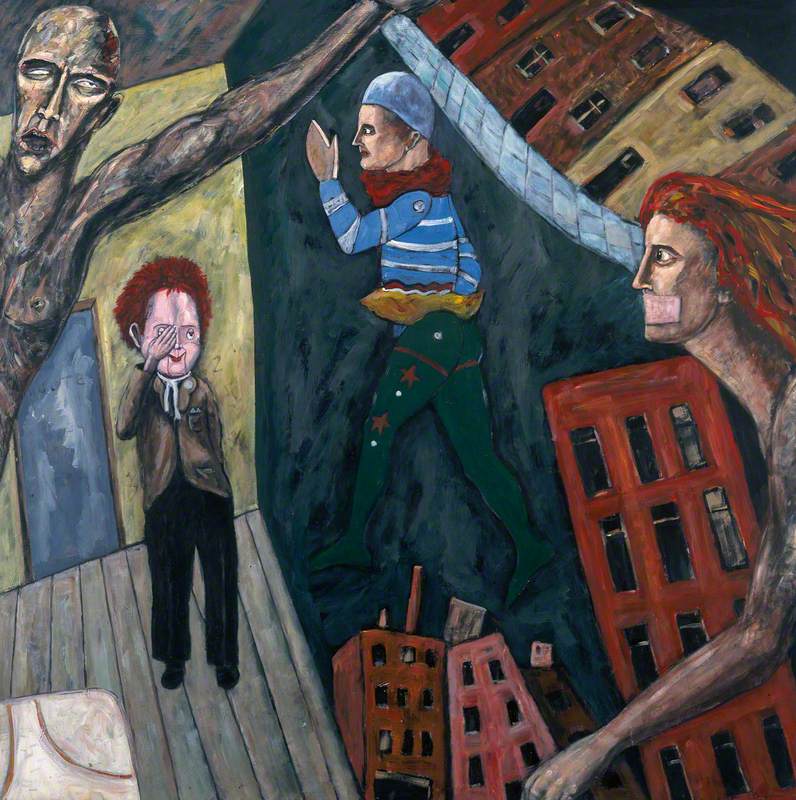
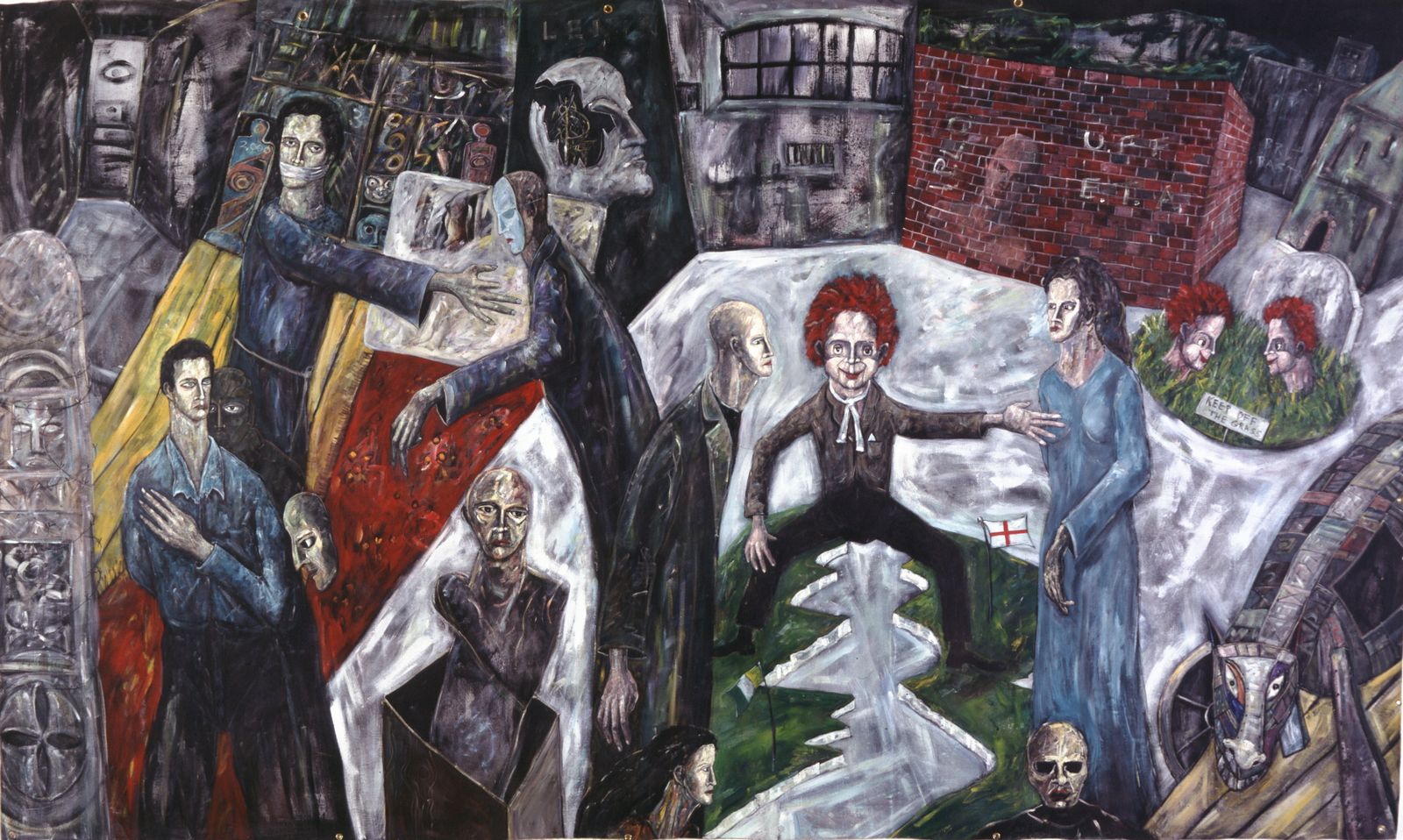
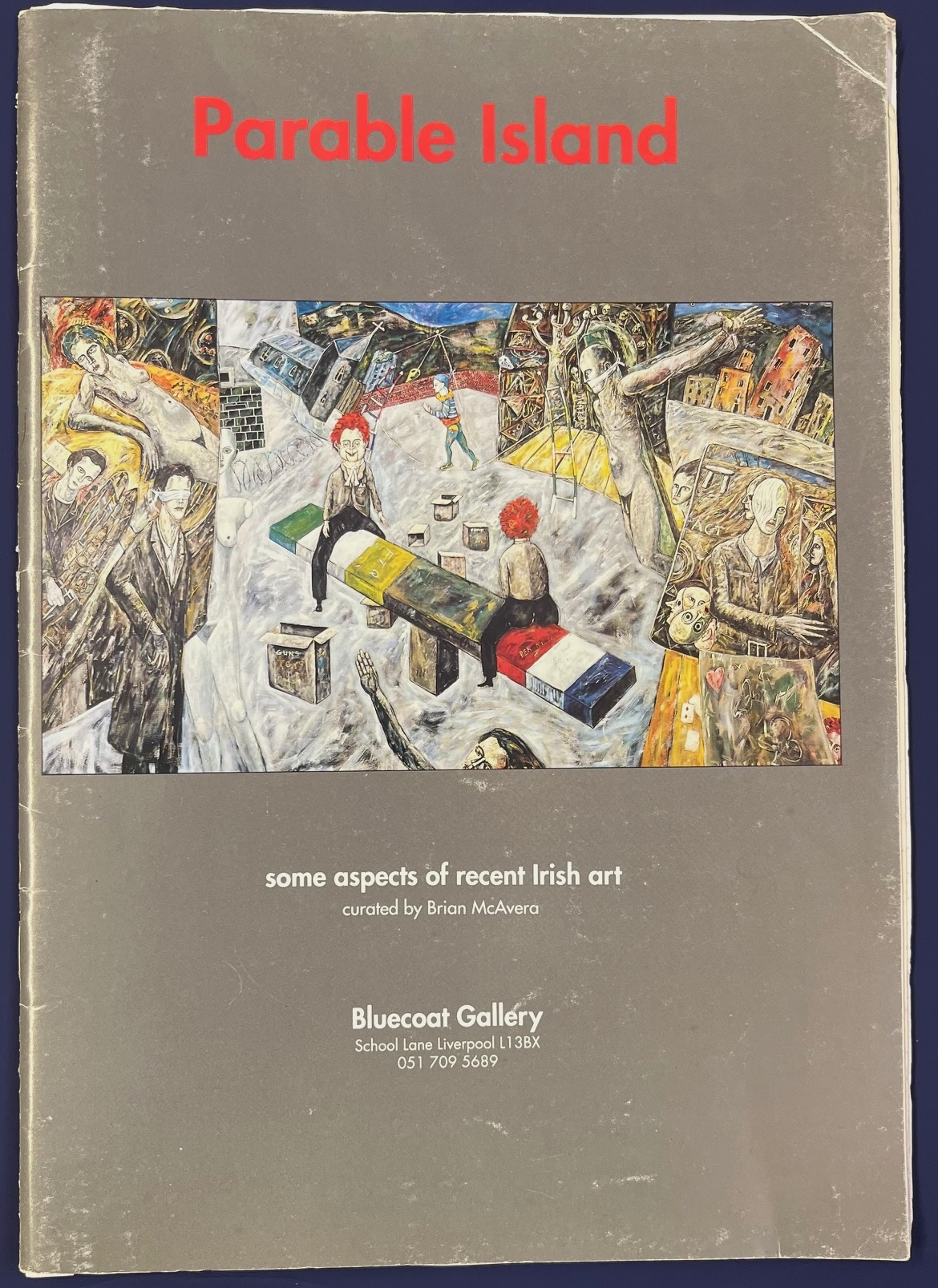
Two paintings by Jack Pakenham: 'Walking the Sky' 1987; 'National Identity Crisis 1' 1995, courtesy IMMA; Bluecoat Gallery exhibition catalogue
Jack is eighty-five now, and still producing work. Let us end with his words on why he bore witness: ‘I did not wish merely to record or illustrate since the camera did this more than adequately, but wanted to produce a kind of collective scream and comment that would work directly on the nervous system, shocking people who had become almost apathetic, anaesthetized over the years by horror after horror, shock after shock’.
Brian McAvera, February 2025
We’ll share new articles inspired by NIVARLA by Brian every week. And you can enjoy more of his writing on his own site here.
NIVARLA will launch formally this Spring, and items in the rare and special collection will be available to view by appointment. We will share more information on how to access and use NIVARLA soon!
The Northern Ireland Visual Art Research Library & Archive is supported by the Ampersand Foundation, with many books and archive items donated and on loan from the McAvera & Walker Library.
Help fund our work
Through a one-off or repeat donation, you’ll enable us to continue showcasing art and culture with our community.
Supported by