
John Berger’s Ways of Seeing is one of the most influential books on art in any language. First published in 1972, it was based on the BBC television series about which the Sunday Times said: “This is an eye-opener in more ways than one: by concentrating on how we look at paintings . . . he will almost certainly change the way you look at pictures.”
I am told that this book is the one most often stolen from libraries. Whatever the truth of that, it is a book that has never been out of print, that has been used in art schools on both sides of the Atlantic for over half a century, and that has garnered the reputation of an iconoclastic classic. I myself well remember the four thirty-minute episodes of the BBC television series in 1972 and my much annotated copy of the book, which is based on the television series, is also dated the same year.
That you should read it, is not in doubt. Although he had been an art student at Chelsea School of Art, one who had become a painter, he was better known, for over a decade, as the art critic of the New Statesman. He was that unusual beast, an art critic who was a Marxist, and one not afraid to machine gun the art establishment, many of whom he regularly antagonized. If Kenneth Clark, over the previous twenty years, had changed the face of arts coverage on television, most famously in 1969 with his twelve-part, sixty-minute long series Civilisation, in came a long-haired, handsome, open-necked young bruiser (not at all like the impeccably dressed and coiffed Kenneth Clark), who changed it yet again.
So what did he do? In matters of style, although, like Clark, he had a gift for words, he was young, irreverent, and very, very direct. In terms of content, unlike Clark, he screamed anti-establishment. He saw art, and British art especially, as being about Class and Capitalism: those houses, those race horses, those swathes of well-manicured land owned by the gentry but worked by the peasantry.
As if that wasn’t bad enough for the establishment, he looked at the portrayal of women, in relation to the History of the Nude, in terms of the ‘male gaze’: women as objects. Even worser (to misquote Spike Milligan) he looked at the world of advertising and the media, and related it directly to Art.
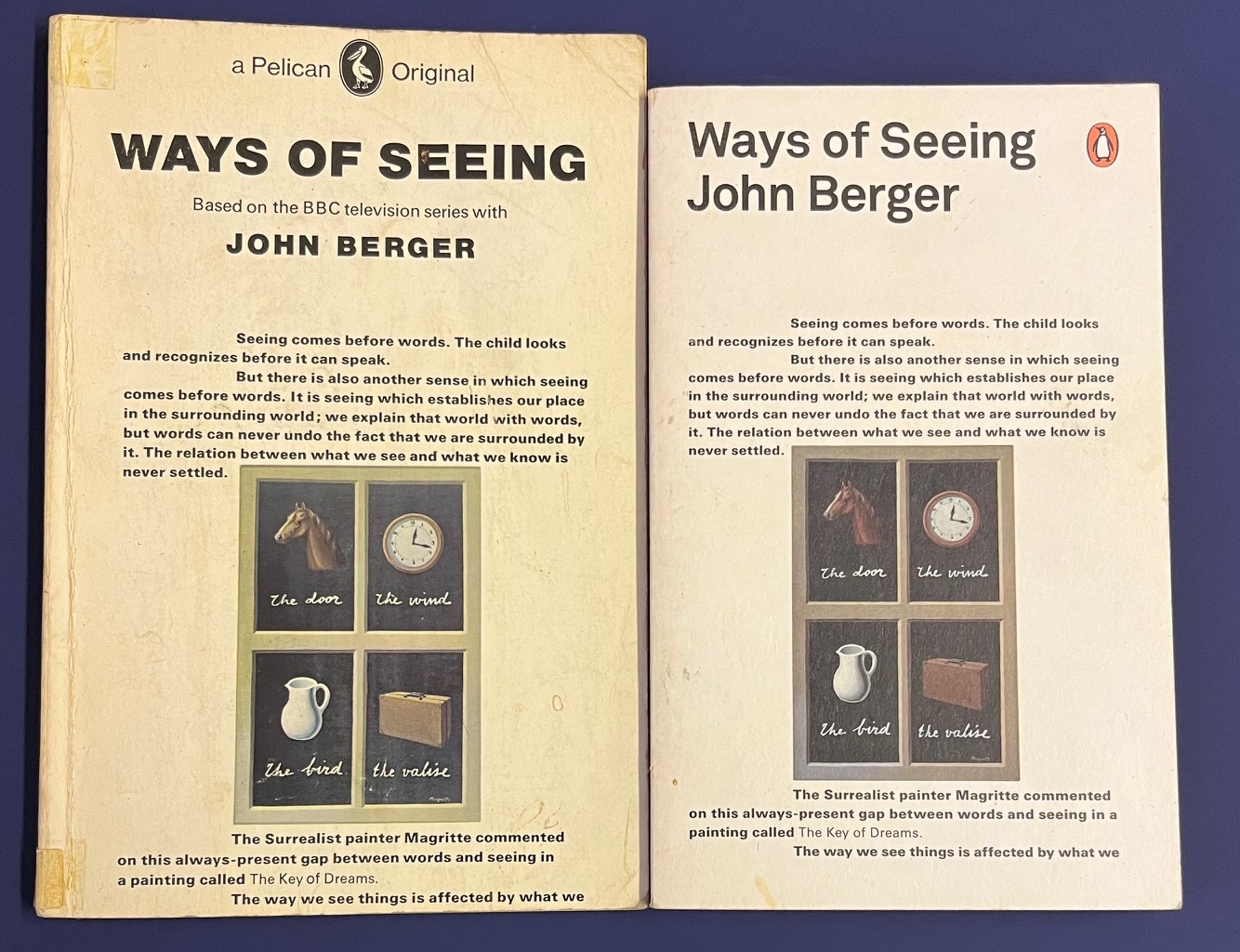
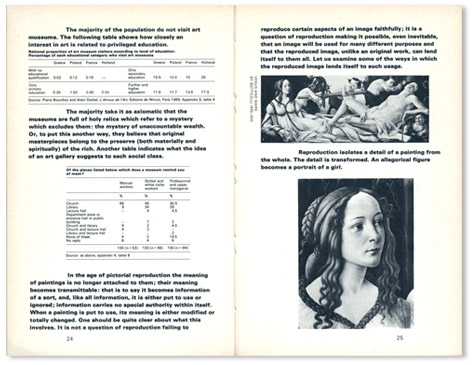
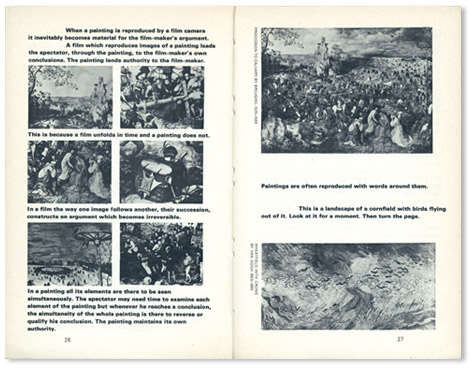
(l-r) covers of two editions and insert pages from 'Ways of Seeing'
The impact of his work was enormous, and still reverberates to this day. But there are questions, not only in relation to Ways of Seeing, the success of which he never again equaled, but also in relation to the man. To take the book first: who actually wrote it? Berger’s name is on the cover of the book, but opposite the title page there is the legend ‘A book made by John Berger, Sven Blomberg, Chris Fox, Michael Dibbs, Richard Hollis.’
Note that word ‘made’: this was a collaboration. Although the names of the collaborators were listed alphabetically, this does not reflect their importance. Although Berger originally wrote the television scripts, Chris Fox is listed as a researcher for all four, and in a note to the reader of the book, we are told that the book ‘has been made by the five of us’ and that the ‘starting point was some of the ideas contained in the television series.’ Of the seven essays in the book, all use images but three of them contain only images. Much of the impact of this book was visual so it was not surprising to find that Richard Hollis, an eminent Graphic Designer, designed the book. Nor was it surprising to find that Michael Dibb was the director of the television series (Berger worked with him regularly), bringing not only visual acumen to the enterprise but also a rigorous assessment and questioning of Berger’s ideas. The odd man out in the list was Sven Blomberg, a Swedish artist, brought in by Berger to provide ‘an outsider’s eye’. Berger has always taken the major credit, but there is little doubt that most of the other five contributed substantially to the book.
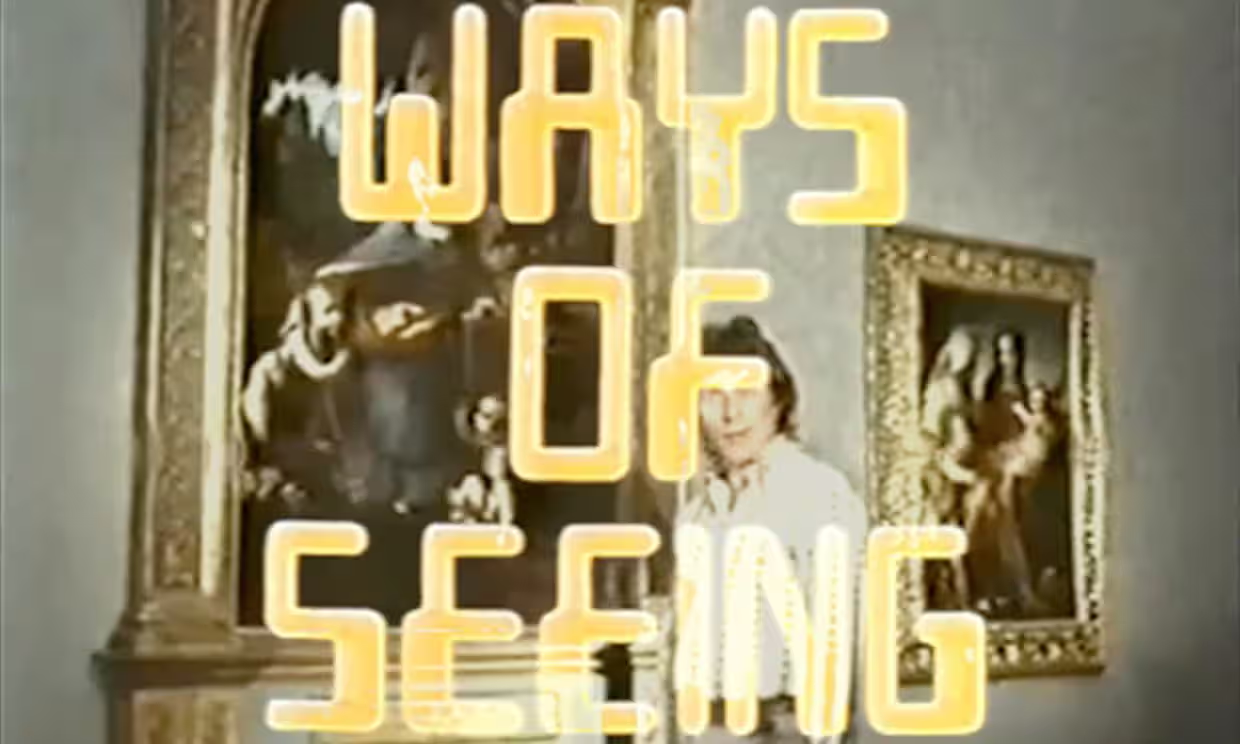

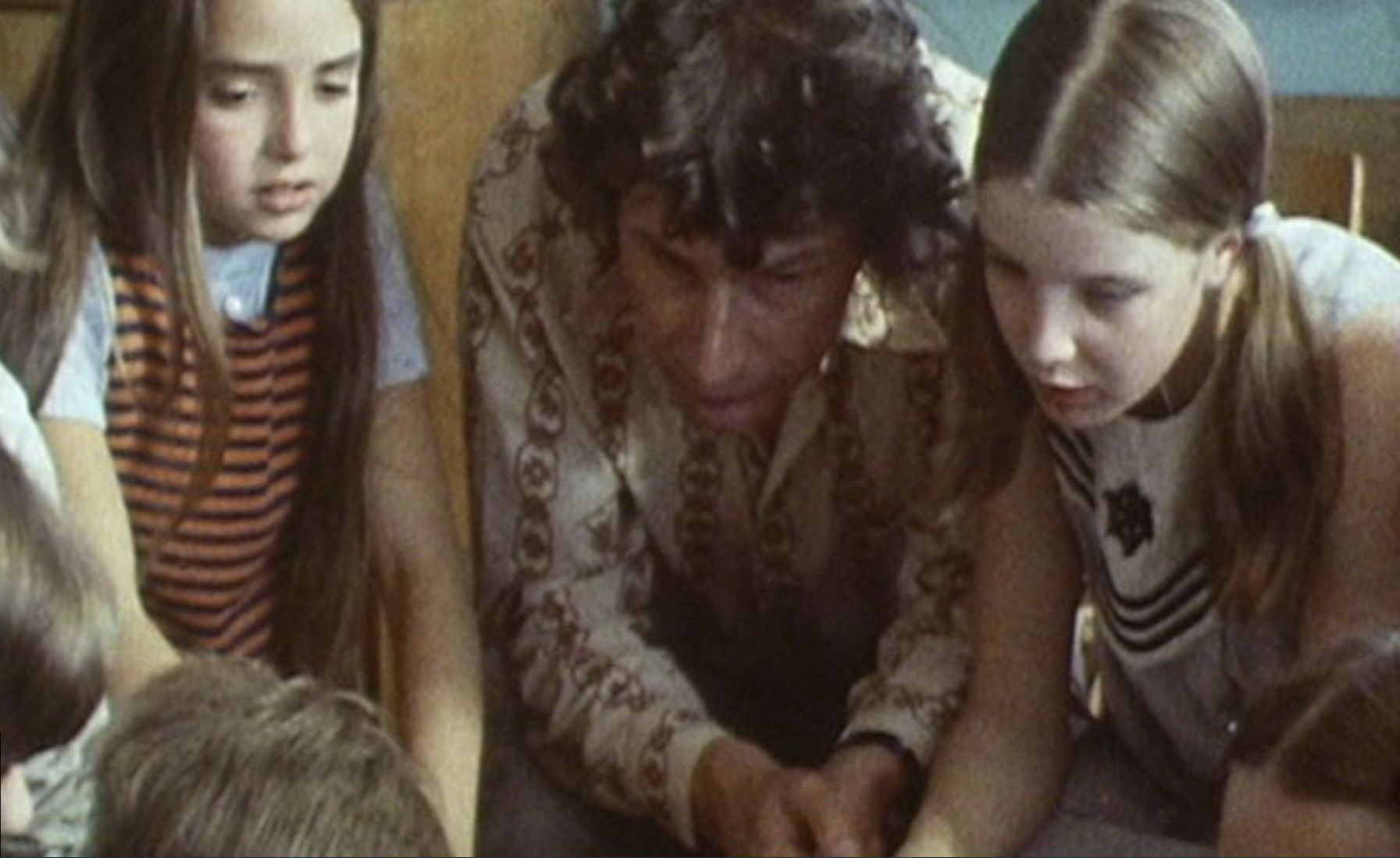
(l-r) Stills from the influential 1972 BBC series
Just how innovative was Berger? In actual fact, as he remarks in the book, many of the seemingly new ideas were in fact taken from the work of the German critic Walter Benjamin, in particular from his essay The Work of Art in an Age of Mechanical Reproduction, which was written forty years previously. Berger popularised them: he didn’t invent them.
If he never again equaled the success of Ways of Seeing, Berger continued to produce books apace: novels, screenplays, books of essays, as well as the occasional monograph such as The Success and Failure of Picasso which basically argued that Cubism was his artistic high point and that after that he lost his revolutionary edge. What gave him his edge was the fact that he trained as an artist, worked as a painter, but knew that he would never be a major artist. As such, when he writes about a painting, or especially about a drawing, there is a bi-focal approach: the eye of the artist combined with the eye of the critic. As a Marxist, he also places the artwork within its socio-political context. As a writer himself, of novels, poetry, plays, and non-fiction, his humanist context is broader than that of most critics.
Berger tends to polarise: you like him or loathe him. His supporters often, mistakenly in my view, stress his probity: his Marxist credentials, his moral stance as when, having won the Booker prize but found out that the money could be traced back to slavery, he promptly gave half of it to the Black Panther movement. He was not averse to creating his own myths as when he claimed to come from a working-class family. He didn’t. The family was middle-class and he as sent to a private school. And as for morality, he spent the last twenty years of his life alternating between the house of his wife and family, and that of his mistress. But, whatever one may say about him, one thing is clear. He changed art criticism and art history for the better.
Brian McAvera, February 2025
Note
The best edition to read, if you can find one, is the first edition. Its format is somewhat larger than the reprints and, crucially, it is printed on chalk-surfaced paper so that the illustrations are crisp whereas later editions are on cheap newspaper-style paper.
Thanks to the McAvera & Walker Library, we have copies of John Berger’s book in the NI Visual Art Research Library & Archive at the Golden Thread Gallery. NIVARLA will launch formally in February, and items in the rare and special collection will be available to view by appointment. We will share more information on how to access and use NIVARLA soon!
The Northern Ireland Visual Art Research Library & Archive is supported by the Ampersand Foundation, with many books and archive items donated and on loan from the McAvera & Walker Library.

Help fund our work
Through a one-off or repeat donation, you’ll enable us to continue showcasing art and culture with our community.
Supported by